Newsletters
Corporate Newsletter – October 2011
 October 12, 2011 |
  Author
 Downside of excess cash
This article appeared in the October 2011 ASX Investor Update email newsletter.
Learn about the dangers of holding too much cash in Self-Managed Super Funds.
 By Robin Bowerman, Vanguard
Self-managed super funds (SMSFs) across Australia are manning the defensive portfolio parapets and their weapon of choice is cash. And this increase in cash holdings may be revealing considerably more than a simple lack of confidence in where the sharemarket is heading in the short term.
A recent research study by Vanguard/Investment Trends looking at the SMSF sector has shown that the so-called “wall of cash” in SMSFs has grown markedly as wary investors say they are waiting for the return of more favourable market conditions before reallocating funds to growth assets.
This may not be surprising but it is potentially a cause for concern if investors are trying to time markets rather than staying on course with a long-term asset allocation plan.
The nationwide survey of more than 3000 SMSF trustees shows that total cash and cash products held by SMSFs in Australia has grown by $40 billion since May 2009 to $113 billion in May 2011.
That is a dramatic increase in the headline numbers but the survey also identified the level of “excess cash” held by SMSFs – defined as funds that would normally have been invested in other investments/assets.
It is interesting that while overall cash holdings jumped significantly over the past couple of years, excess cash holdings have remained stable in terms of value at $39 billion, but now represents 35 per cent of SMSFs’ total cash holdings, down from 53 per cent in May 2009.
The research is suggesting that the role of cash within SMSF portfolios is undergoing a change in status, from parking place to permanent fixture.
The implications of this excess cash declining and overall cash levels rising may be that what investors once considered the “waiting to invest” portion of their portfolio has now been re-categorised to form part of the broader fixed-interest asset allocation. (Editor’s note: Do the ASX online interest rate securities course to learn more about the features, benefits and risks of fixed-interest products.)
That raises the bigger question of what is the role of fixed interest within a portfolio?
Potential risks
A larger cash allocation may appear an attractive option at the moment with bank term deposits providing rates of around 6 per cent per annum. US and European investors would look at those rates with envy.
However, over the long term, investors need to feel confident that their asset allocation is aligned to their risk/return profile and also their time horizon. Investors also need to understand the potential risks involved in having a portfolio that is overweight in cash.
Fixed interest is crucial to a well-diversified portfolio. In addition to providing regular income, it acts as a counterbalance to the inherent volatility of growth assets and also helps moderate a portfolio’s downside risk. The fixed-interest asset class also provides capital stability and lowers the variability of portfolio returns.
While these characteristics may sound a lot like term deposits, comparing the two side by side reveals some key differences, in particular, time and liquidity.
Beyond their initial similarities of regular income flow and limiting capital growth or loss, differences start to appear when we examine risk versus return. Cash has a low risk/return profile but is inherently short-term, at six to 12 months, whereas fixed interest offers a more medium risk/return profile with a typical investment horizon being three to five years.
An investor’s risk/return decision is heavily influenced by their time horizon. Cash in a term deposit usually requires a minimum timeframe of three, six or 12 months; fixed interest or bonds are more suited to those with at least a three-year outlook. So although a higher cash allocation may be appropriate for a retiree to cover a year or two of living expenses, for an investor with a decade or more to go to retirement, a broader exposure to fixed interest may be more appropriate.
Fixed-interest investing is also a lot broader than cash or term deposits and can span a wider risk spectrum. It could consist of highly defensive assets such as Australian or US government bonds, expand further to include semi-government bonds and supranational borrowers (i.e. The World Bank) or, moving along the credit risk curve, incorporate high-quality corporate bonds (think Toyota and BHP) all the way out to high-yielding so-called junk bonds.
The key point is that fixed-interest investing is broad; indeed, the fixed-interest markets globally are larger and more liquid than global sharemarkets. But in Australia our fixed-interest marketplace is relatively small, less visible and less understood – perhaps a positive, albeit unintended, consequence of having a Federal Government running budget surpluses for many years.
Indeed, one of the reasons SMSFs are retreating to term deposits as a quasi fixed-interest portfolio allocation – apart from the attractive short-term rates – is the lack of awareness and ability to access broader fixed-interest investments such as government bonds. Managed funds do offer broad fixed-interest products but they have not seen strong take-up among SMSFs.
SMSFs are often more likely to access investments directly. And while the Australian exchange-traded funds (ETFs) market in shares is growing strongly, fixed-interest ETFs are not yet able to be offered under the existing regulatory framework.
Benchmark portfolio
The asset allocation decision is most important for investors when it comes to their portfolio’s risk-and-return profile.
For anyone running their own SMSF, having a benchmark portfolio to measure yourself against can be a valuable, dispassionate tool. The Vanguard diversified funds are all index funds so they reflect market returns over the past eight years.
The portfolios range from conservative to high growth. In the conservative portfolio the cash allocation is 42 per cent while Australian and international fixed interest holdings are 11 per cent and 17 per cent respectively, giving a total allocation to income assets of 70 per cent. By contrast, the balanced portfolio has 50 per cent in cash and fixed interest, and 50 per cent in growth assets.
Another key consideration for someone running their own SMSF is the need to rebalance the portfolio. Periods of volatility can change the allocations, so it is important to monitor and rebalance periodically to keep the same risk profile.
The harsh reality is, being under or over-invested in different asset classes at the wrong time can have a significant impact on an investor’s return. Getting market timing right is an extremely difficult task that can often leave investable funds on the sidelines during periods of strong returns.
History has shown that allowing emotions to drive investment decisions – be it overconfidence in rising markets or fear in falling markets – rarely serves investors well; and that over the long term, investors have traditionally been rewarded for showing patience and discipline around their investment strategy and diligence in rebalancing portfolios back to target asset allocations.
No one can be certain of what sort of volatility to expect from markets. However, we do know that previous periods of excess volatility have clustered around global macro events; and that during those periods, well-diversified portfolios that included allocations to less risky assets such as fixed interest and/or cash tended to ride out the storm much more smoothly.
So, while times like these can be unsettling for investors, those who have determined an appropriate asset allocation and who rebalance as necessary, are in a better position to weather periods of uncertainty, as well as the inevitable market dislocations to come.
About the author
Robin Bowerman is Head of Corporate Affairs and Market Development at index fund manager Vanguard Investments Australia.
From ASX
The ASX ETF course has seven modules covering the fundamentals of what ETFs are and how to buy and sell them. Subsequent modules take a detailed look at particular types of ETFs, including a case study.
The modules are self-directed, meaning you can work through them sequentially or go from, say, domestic ETFs to international ETFs or exchange-traded commodities (ETCs). Each has summary slides and a quiz to help you be confident you have grasped the concepts.
Best of all, you can do the online course when and where you like, at your own pace, and print the notes. All you need is an internet connection and computer.
Blue-chip income stocks
This article appeared in the October 2011 ASX Investor Update email newsletter.
What the charts say about fully franked shares that yield at least 10%.
 By Alan Hull, author
How does someone get their hands on double-digit returns in such a weak sharemarket? Until late 2007 it was as easy as falling off a log with the Australian sharemarket powering along at well in excess of 10 per cent annually. Below is a chart of the All Ordinaries index showing the market’s meteoric rise from early 2003 to late 2007.
All Ordinarires Index chart – 2000 to 2011
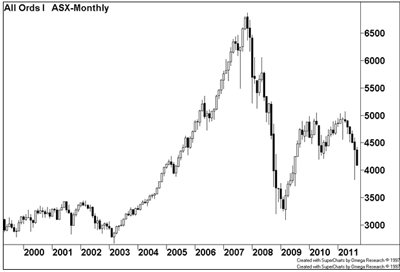
Alas, these good times are behind us and the Australian sharemarket has been in the doldrums since 2008. In fact it is currently forming a major low, which can be seen in the following chart of the All Ords that goes back to the 1987 crash.
All Ords chart trendline – 1987 to 2010
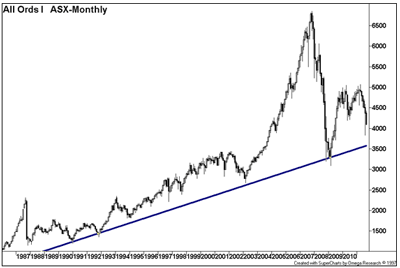
The chart above shows how the market is trending downwards and that there is still, potentially, a little distance to go before we hit the long-term trendline.
I would hope this trendline provides some support, but it is actually more than 10 per cent away from where the market is trading at the time of writing. So if you were thinking of buying shares right now in the hope of realising some capital growth in the near future, I would think again. There is a danger of our market falling further in the short term.
Warren Buffett would probably be happy
In my view, this is not a time to be buying shares for capital growth but rather a time to be focusing on income shares that pay reliable dividend yields. In other words, this is Warren Buffett’s time and that is why we have been hearing and seeing so much of him in the financial news. Is it possible that, like him, we too can find shares yielding double-digit returns? The short answer is yes.
What is more, most of these high-yielding shares are to be found in the top 25 ASX-listed companies, based on market capitalisation at the time of writing. I’m not declaring that Buffett would be happy with the fundamentals of these companies, but he certainly has demonstrated through his own investment choices that he would be happy with their yields.
Let’s take a closer look at these high-yielding blue chips, starting with the Big Four banks. (Editor’s note: For a fundamental view on banks stocks, read the article by Clime’s Matthew Koroi in this issue.) I don’t think it is necessary, or helpful, to analyse them separately for the purpose of this exercise, so I’ll list their vital statistics together).
| Code | Price | Div. yield | Franking |
|---|---|---|---|
| ANZ | $19.32 | 7.14% | 100% |
| CBA | $45.11 | 7.09% | 100% |
| NAB | $22.48 | 7.21% | 100% |
| WBC | $19.31 | 7.77% | 100% |
I have included franking (tax credits) because this must be taken into consideration when working out the true yield of these shares. For all the Big Four, the franking is 100 per cent, which means the banks have paid the full amount of company tax owing (at 30¢ in the dollar) on 100 per cent of their earnings.
To encourage investment in shares, the Federal Government many years ago decided that the tax paid by companies could be passed on to investors in the form of tax credits. So not only does ANZ Bank pay out an annual dividend yield of 7.14 per cent (at the time of writing) but it also comes with a tax credit of 30¢ in the dollar.
To compare apples with apples when it comes to dividend yields, it is necessary to “reverse out” the tax credits. In the case of 100 per cent franking this is achieved by simply dividing the dividend yield by 0.7.
Therefore ANZ’s grossed-up dividend yield = 7.14%/0.7 = 10.2%
And bingo, ANZ is yielding just over 10 per cent per annum when we take the tax credit into account. In fact, any dividend yield equal to or greater than 7 per cent that comes with a tax credit of 100 per cent will gross up to 10 per cent or more. Hence, all the Big Four banks at the time of writing are yielding just over 10 per cent per annum when their franking credits are taken into account.
I will include a small caveat here, because not everyone can make full use of the tax credits received because they do not pay that much tax in the first place. This is particularly relevant to superannuation funds, where the tax being paid can often be very low and in many cases is well below 30¢ in the dollar. To find out if you can make full use tax credits, speak to your accountant and/or financial planner.
I should mention that the forward projections by the Big Four are for an increase in their dividend payments over the next couple of years. I am fairly comfortable with the idea of buying and holding their shares for the long term, given that the banks’ long-term future prospects are generally very good, in my opinion. Our banks seem to have mastered the ability to prosper in both good times and bad, if the GFC is anything to go by.
If we take ANZ’s share price to be reasonably indicative of all of the Big Four, which I believe it is, then we can employ it as a sort of charting proxy for this group. The following chart shows ANZ (red line) overlayed with the All Ordinaries index (black line), demonstrating how similar the behaviour of the four banks has been to the All Ords over the past 10 years.
ANZ bank chart overlaid with All Ords – 2001 to 2011
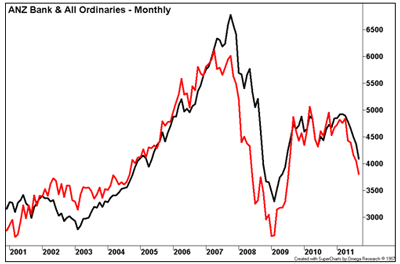
This is important, because it suggests the four banks will probably recover along with the broader share market. I’m not sure when that will happen, but it will. Therefore I believe these banks are currently an attractive proposition as income shares and their prices will ultimately recover from their current lows.
Telstra
I’m not so sure about Telstra, another stock in the top 25, even though it is currently yielding a very attractive 9.33 per cent plus 100 per cent tax credits: a grossed-up dividend yield of 13.33 per cent.
Telstra monthly chart – 2000 to 2011
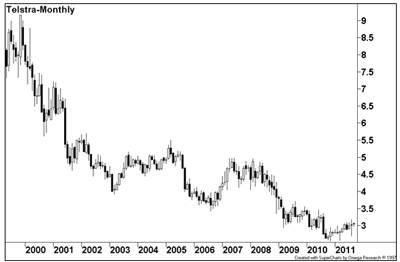
Investors have moved away from Telstra shares over time; a very attractive dividend yield has been offset by a falling share price.
QBE Insurance
To the last share in the top 25 that is yielding double-digit returns, QBE, which has a grossed-up dividend yield of 10.15 per cent annually. But again, here is another share price that has been constantly on the decline for the past several years and therefore it has me a bit spooked as well.
QBE monthly chart – 2006 to 2011
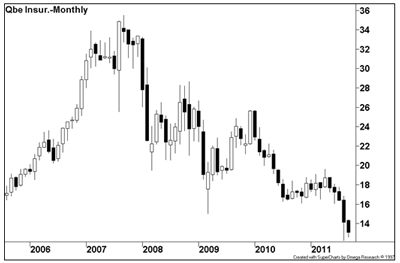
What is the point in chasing high yields if they are just going to be gobbled up by a constantly falling share price? Mind you, I don’t think QBE is in the same boat as Telstra in terms of its business model, but right now its share price is clearly in a very well-established downtrend.
I would be inclined to wait for signs of a reversal in QBE’s long-term downtrend and then take another look at it. Hence, even when assessing and acquiring income shares, I still bring every skill I have to the table: fundamental and technical analysis, an understanding of the broader economy, and my business acumen.
About the author
Alan Hull is a share trader, fund manager and author of the investment books Blue Chip Investing and Active Investing-A Complete Answer. More information is available at www.alanhull.com.au. To request a copy of his PDF chapters on how to identify and manage asset class shares (income), emails to enquiries@alanhull.com
From ASX
The ASX website has a wealth of free education material on charting. Visit the ASX Charting Library for stories that suit beginners through to advanced technical analysts.
The views, opinions or recommendations of the author in this article are solely those of the author and do not in any way reflect the views, opinions, recommendations, of ASX Limited ABN 98 008 624 691 and its related bodies corporate (“ASX”). ASX makes no representation or warranty with respect to the accuracy, completeness or currency of the content. The content is for educational purposes only and does not constitute financial advice. Independent advice should be obtained from an Australian financial services licensee before making investment decisions. To the extent permitted by law, ASX excludes all liability for any loss or damage arising in any way including by way of negligence.
Big banks offer value
This article appeared in the October 2011 ASX Investor Update email newsletter.
See why Clime believes the Big Four are trading at a discount to intrinsic value.
 By Matthew Koroi, Clime
Although banks earn revenue in many ways, their main income comes by lending money at a higher rate than they pay for money deposited with them. This is referred to as the net interest margin. Over the past 15 years, banks have placed more emphasis on non-interest income, such as fees, to increase their profits, and today non-interest income represents between 30 per cent and 40 per cent of the major banks’ total revenue.
When analysing a bank, five financial metrics often referred to are:
- Return on equity: Clime likes to see a bank achieving a standard ROE of around 20 per cent.
- Return on assets: We like to see a bank achieving ROA of approximately 1 per cent.
- Cost-to-income ratio: A figure we would like to see declining over time and trending towards 40 per cent of net revenue.
- Net interest margin: The difference between average interest cost and average interest earned.
- Asset growth and a reduction in impaired assets (assets that have to be written down).
In determining the business risk of a bank, Clime focuses on five areas:
- Liability risk: The risk of depositors’ requests for withdrawals being in excess of a bank’s available cash. This is well regulated by the Australian Prudential Regulation Authority, which monitors banks’ capital adequacy and liquidity.
- Credit risk: The chance that those who owe money to the bank will not repay it.
- Interest rate risk: “Margin squeeze”, the situation where rising interest rates force a bank to pay more on its deposits than it receives on its loans.
- Derivative books: In the modern banking world, banks earn revenue from derivative books and proprietary trading. This is a higher-risk way to generate returns, and an example of when things can go wrong was highlighted in 2003 when National Australia Bank lost about $360 million in a foreign exchange “rogue trading” incident.
- Credit growth: Savings rates in Australia are the highest they have been in 15 years and credit growth across all sectors – housing, business and personal – continues to fall. The combination of this reflects growing conservatism since the GFC. Although this is a negative for banks’ shareholders, when credit demand picks up it will result in more loans being written and will drive up net income. This should lead to improved profits and profitability.
Investing for yield
Given the volatility of financial markets over the past four years, many retail investors perceive a higher level of risk in the sharemarket. Reserve Bank data shows the percentage of total household assets being allocated to the sharemarket is the lowest it has been since the early 1990s, at around 4 per cent.
If you look through the current share price action of banks, with a long-term focus on wealth creation, the recent market volatility need not turn you off shares. By identifying profitable businesses that reward shareholders with consistent and sustainable dividends, you are able to ensure a steady income stream despite erratic short-term price movements.
In a general sense, when analysing companies for yield, Clime tends to find the best businesses display the following five characteristics:
- Dividends are consistent and sustainable
- Dividends are franked
- Dividends are paid from the business earnings and supported by real cash flows, not recent capital raisings
- Yield is in excess of 6 per cent
- The business has a record of growth in dividends per share.
In relating these characteristics to the banks, we can tick off each one of them.
Over the past two decades the average dividend yield of the Big Four banks has been roughly 5.8 per cent.
At an average of 7.5 per cent (based on prices at September 20, 2011), the yield currently available on the Big Four banks is high in a historical context. Including the benefit of franking, this figure is around 10.7 per cent.
The yield available on bank shares is also attractive in a relative sense when compared to other asset classes, such as interest-bearing bank accounts and investment property.
Using Clime data, the following tables compare a range of financial figures of the various types of banks in Australia.
The majors
| Bank | Market Cap* | FY11 ROE | FY11 ROA | FY11 net interest margin | Grossed up yield (for franking credits)* |
|---|---|---|---|---|---|
| ANZ^ | $50.8bn | 14.74% | 0.95% | 2.51% | 10.00% |
| CBA | $68.7bn | 18.60% | 1.02% | 2.11% | 9.70% |
| NAB^ | $48.4bn | 11.76% | 0.67% | 2.40% | 10.30% |
| WBC^ | $58.3bn | 15.42% | 0.95% | 2.15% | 11.00% |
* Current at close Sept 20, 2011
^ FY2010Regional banks
| Bank | Market Cap* | FY11 ROE | FY11 ROA | FY11 net interest margin | Grossed up yield |
|---|---|---|---|---|---|
| BEN | $2.9bn | 8.73% | 0.63% | 1.78% | 10.5% |
| BOQ^ | $1.5bn | 8.56% | 0.53% | 1.49% | 11.1% |
* Current at close Sept 20, 2011
^ FY2010Investment banks
| Bank | Market Cap* | FY11 ROE | FY11 ROA | FY11 net interest margin | Grossed up yield |
|---|---|---|---|---|---|
| MQG | $7.4bn | 8.41% | 0.613% | 1.15% | 8.7% |
* Current at close Sept 20, 2011(Editor’s note: Do not read the commentary as share recommendations. Do further research of your own or talk to your financial adviser before acting on themes in this article).
From our perspective, the majors are the safest and best performing of Australian listed banks, with each displaying stronger balance sheets, return on equity, return on assets and net interest margins. To whittle that list down further, Clime’s favoured banks are CBA and ANZ.
The Asian growth strategy of ANZ is positive from an investment perspective, because Asia offers the best economic growth profile globally at present (although not without higher risk and potential capital raisings for acquisitions). The recent financial performance of CBA is excellent and its strong metrics and clear strategy suggest it is the best-performing locally focused bank.
Westpac is interesting and may surprise, with increasing synergies from the St George acquisition driving further cost reductions, a multi-branded strategy with a high-quality lending book, and potential wealth-management leverage should equity markets remain sound.
A further indication of the strength of Australian banks is that of the 10 AA-rated banks in the world, Australia’s Big Four are all represented. Only one bank in the world, Rabobank, is rated AAA. This is not to say there is absolutely no chance of the big Australian banks ever failing, but it does mean the risk is somewhat lower in a relative sense.
Investing in shares always carries higher risk than investing in other asset classes such as property or interest-bearing securities. The trade-off, however, is the potential for higher returns. By investing in Australian banks at current levels with a longer-term view, not only are investors able to achieve above-average yields but they are leveraged to the future growth of the economy when favorable business conditions return.
At the time of writing this report, Clime finds each of the Big Four banks to be trading at discounts to their intrinsic value.
About the author
Matthew Koroi is a senior analyst at Clime Asset Management.
From ASX
Use the Search Dividends function on the ASX website to find dividend information.
Boring is beautiful
This article appeared in the October 2011 ASX Investor Update email newsletter.
Why reliable, higher-yielding utility stocks appeal in volatile markets.
 By Nathan Bell, Intelligent Investor
Europe, we are told, is on the brink of financial disaster. The brink happens to be a crowded place right now, with America and Japan nestled comfortably on the same precipice. With markets swinging wildly, utility and essential infrastructure investments have seldom been more attractive.
Whether its gas pipelines, electricity networks, toll roads, airports, or power stations, a combination of monopolistic assets, regulated returns and stable cash flows are supposed to offer conservatism and stability. An antidote, in other words, to the chaos. However, like most conventional wisdom, those truths need to be tested.
The good and the bad
Because of deregulation, a distinction has emerged between what constitutes a utility, such as energy giants AGL and Origin Energy, and what are more accurately termed essential infrastructure businesses, such as Spark Infrastructure and SP AusNet. But what you really need to know is that both categories have attractive characteristics; many assets are natural monopolies so they face limited competition. It only makes sense, for example, to build one set of pipelines and power grids. Cash flows are predictable, too.
These companies own a mix of regulated and unregulated assets. Spark Infrastructure and SP AusNet operate the “poles and wires” of the electricity grid – a natural monopoly. Because their prices are regulated and there is no competitive pressure, returns are predictable and stable. A large lick of debt in such instances is bearable. Origin Energy and AGL, however, are retailers of electricity, an unregulated activity subject to fierce competition. Too much debt in this scenario could be dangerous.
In the past, Intelligent Investor has been wary of the utility sector because of its excessive debt and unsustainable dividends. These remain key areas of concern, although predictable cash flows mean infrastructure assets can often carry higher-than-average levels of debt. Investors need to be judicious in deciding when debt is OK and when it’s not.
Dividends also deserve attention; higher is not necessarily better. It is important to measure dividends paid against cash the business generates. Energy and infrastructure assets have a habit of generating profits without generating cash. This neat trick is done by revaluing assets as a profit, an activity that does not add to the business cash pile. Be sure to check cash flow and profits to see if one is turning into the other.
A dividend that is too high could also signal a future capital raising. Take Spark and SP AusNet as an example. Both need to reinvest in their distribution networks to increase regulated returns, so require heavy doses of cash. Spark pays only about half its cash flow as dividends, leaving cash to reinvest. Spark’s dividends may be lower than SP AusNet’s, but they are also more sustainable and will grow, in Intelligent Investor’s opinion.
Three of the best
(Editor’s note: Do not read the following ideas as share recommendations. Do further research of your own or talk to your financial adviser before acting on themes in this article.)
Selecting the business in which to invest is the next step. Predictable cash flows and high yields have traditionally attracted income investors to infrastructure companies. There are, however, some utility and infrastructure businesses that can potentially grow, too. Spark Infrastructure, MAp Group and Origin Energy fall into this category, according to Intelligent Investor’s research.
1. Origin Energy
Origin operates in the non-regulated parts of the electricity sector. Although retail prices are regulated, there is a twist. Regulatory bodies, such as IPART in NSW, set the maximum price that retailers such as Origin and AGL can charge customers. But in urban markets, for example, where the cost of supply is low, price competition means Origin can fight for customers and charge less than the regulated tariff, yet earn higher returns than most regulated businesses.
Origin’s real competitive advantage, though, lies in an area where there is no regulation at all: power generation. Under the intelligent stewardship of chief executive Grant King, who realised early that energy assets would become more valuable; Origin assembled some of the biggest and best gas and electricity generation assets in the industry at a fraction of what they would cost today. With a massive pool of cheap production and generation capacity, price regulation is not a big deal. Origin’s growth has come not from the largely regulated price at which it sells energy, but from the low costs of producing it. As a low-cost producer of power, it is well placed to compete aggressively.
Although the largest portion of profits comes from retailing energy, Origin also has a significant oil and gas production business that it intends to grow. A large coal seam gas-to-LNG project in Queensland could well transform the company, making the production side of the business far more important. Although Origin is morphing into more than a simple utility, its prospects are attractive.
2. Spark Infrastructure
Spark owns essential infrastructure and charges other companies a fee to access it. The business model appears simple enough but understanding what fees the companies are allowed to charge is more complicated.
Spark owns stakes in energy distributors ETSA, Powercor and Citipower, which have monopoly control over the electricity network in their respective geographic regions. As a result, the government-sanctioned Australian Energy Regulator (AER) controls how much they can charge their customers. Crucially, the return Spark is allowed to earn depends on how valuable its asset base is, which is determined by the value of its assets in the prior year, less depreciation plus fresh capital expenditures. The more money Spark spends on capital expenditure, the more the regulator allows it to earn.
Because Spark is in the midst of a major expenditure cycle (which, incidentally, is the reason everyone’s electricity bills are rising), returns from the three underlying assets are forecast to grow 8 per cent a year over the next four years. And thanks to the diligent use of debt, Spark’s interest in those assets will increase by 14 per cent a year over that time. A reasonable yield of more than 7 per cent (unfranked) will continue to be paid, but with plenty of cash to fund expenditure, Spark is one infrastructure business with genuine growth prospects.
3. MAp Group
MAp Group is not an energy utility, but it will own 85 per cent of Sydney Airport and, if you have used it, you will instantly understand why airports make wonderful businesses. Park your car in the one of the most expensive airport parking lots in the world, and then venture into the terminal itself and you notice that Sydney Airport has been transformed into a mini-Westfield, complete with captive shoppers and lucrative rents. From parking charges to rents and aircraft charges, Sydney Airport is a fee-fest. As a customer, it’s annoying. As an investor, it’s a goldmine; the closest thing to an unregulated monopoly.
MAp is in the happy position of being able to charge what it likes for most of its services and not having to worry about competition. But having so much power also brings risk. If MAp gouges profits too fiercely, the risk of government intervention and reregulation is ever present. The company runs a fine balance between maximising returns without putting off regulators.
The company will soon pay a special distribution of 80¢ per security, and generally offers a distribution yield of about 6 per cent. Although MAp is an attractive business, it is exposed to some specific risks; any event that would severely cut travel volumes through Sydney Airport, such as industrial action, or a weather or health scare, would have a big impact. Keep this in mind when allocating capital.
Utility and essential infrastructure companies such as these may seem a little boring but many investors will happily welcome a little less excitement right now.
About the author
Nathan Bell is research director of Intelligent Investor. Access a free trial.
From ASX
ASX Infrastructure Funds has information on the features, benefits and risks of investing in listed infrastructure funds.
The views, opinions or recommendations of the author in this article are solely those of the author and do not in any way reflect the views, opinions, recommendations, of ASX Limited ABN 98 008 624 691 and its related bodies corporate (“ASX”). ASX makes no representation or warranty with respect to the accuracy, completeness or currency of the content. The content is for educational purposes only and does not constitute financial advice. Independent advice should be obtained from an Australian financial services licensee before making investment decisions. To the extent permitted by law, ASX excludes all liability for any loss or damage arising in any way including by way of negligence.
© Copyright 2011 ASX Limited ABN 98 008 624 691. All rights reserved 2011.
 Posted in
Finance Newsletter – October 2011
Mercia’s Mortgage Brokers
Have you checked your home or investment loan recently?
Rates are all over the place, as the jury is out re the future economic direction.
Want to save interest, how about fixing your rate?
We have a fixed rate of 6.33% for 1 or 3 years. That’s got to be less than you are paying now, and you won’t have to worry about any future increases.
If you don’t want to fix your rate, the answer may be to find a low variable rate. What’s your current variable rate?
Current variable rates are as low as 6.80%. This is not a honeymoon rate for a year or so, it’s discounted for the life of the loan. There are great deals available if you know where to look.
We may be able to find you a better rate at your existing bank, and if not we can do the paperwork to refinance you to a better deal. Some banks are currently offering to pay your fees to switch banks. A broker can show you exactly how much you can save and do the paperwork for you.
If you or anyone you know are suffering “mortgage stress” do something about it now!
If a borrower gets behind or is late with a payment the options to restructure/refinance and ask for help are diminished. Don’t be afraid to ask for help.
Call Dan Goodridge on 0414 423 340 or or e-mail dg@iinet.net.au at Mercia Finance if you require any type of finance information.
Corporate Newsletter – September 2011
Carbon tax winners
Learn which sectors and shares have most to gain – or lose – from the tax.
 By Victor Bivell, Eco Investor
The planned introduction of a carbon tax in July next year has already given a big boost to the clean energy sector, which was dealt a huge blow and is yet to recover from the Government’s failure to introduce the Carbon Pollution Reduction Scheme (CPRS) in 2009.
The share prices of most clean energy companies are yet to return to their levels of that time, but the sharp kick up for many when the carbon tax was announced means they are at last starting to point in the right direction.
Sharemarket history is full of industries and companies that have risen and fallen, developed or been held back, through changes in government policy. Agriculture, mining, oil, gas, and power generation are examples of key industries that have long benefited and still profit from government policy.
Changes in policy add another layer of risk to the market, which is why investors prefer governments to be consistent. Since the failure to introduce the CPRS, the clean energy sector has been asking for consistency and is hoping it now has it.
The Government has put its substantial policy and fiscal power behind the sector. Along with the carbon tax, it has introduced several major programs to speed its development: the $10-billion Clean Energy Finance Corporation, the $3.2-billion Australian Renewable Energy Agency, and the $200-million Clean Technology Innovation Program.
Between the carbon tax and the $13.4 billion in backing for these programs, the first message to the market is one of sentiment: the Government wants the clean energy sector to succeed.
The carbon tax will make renewable energy more price competitive with carbon energy, and the other programs will improve the commercial viability of renewable energy technologies such as solar, wind, geothermal, wave, and biofuels. The market responded with an immediate jump in share prices in these companies.
Wind and solar companies
(Editor’s note: Do not read the ideas below as share recommendations. Do further research of your own or talk to your financial adviser before acting on ideas or themes in this story.)
Companies that currently provide clean energy and should benefit from the tax and related measures are wind farm developer Infigen Energy, solar and wind developer CBD Energy, and solar installer Solco. Another is fuel cell developer Ceramic Fuel Cells, which is at the stage of making its first sales.
Another group that can benefit are Australia’s two listed carbon offsets providers, CO2 Group and Carbon Conscious. These companies plant native trees to offset the carbon emissions of large corporations, including some listed companies.
Also anticipating to benefit is consultant Pacific Environment, which assists companies to monitor and report their greenhouse gas emissions.
However, most clean energy developers are at an early stage in their commercialisation and are not expected to become energy suppliers for a number of years. At present they are mostly speculative technology shares with a high level of risk.
That did not stop the environmental technology punters. The tax and other polices immediately spurred almost the entire emerging geothermal energy sector, which is aiming to produce zero emissions baseload power. Geodynamics, Petratherm, Greenearth Energy, KUTh Energy, Torrens Energy and Hot Rock all had big share price rises.
Other early-stage companies whose shares responded to the carbon tax announcement were wave energy developer Carnegie Wave Energy, photovoltaics developer Dyesol, algae-for-biofuels developer Algae.Tec, and waste-to-energy developer WAG.
Not surprisingly, almost all these companies have welcomed the carbon tax.
But there is a long way to go before Australia runs on clean energy and before these companies can turn into profit makers and dividend payers.
In the short term the tax must pass through Parliament; in the medium term it must resist Coalition threats to repeal it; and in the longer term at least some of the emerging renewable energy technologies must prove they can provide substantial baseload energy at a profit.
Australia is fortunate that its clean energy sector, while nowhere as big as it needs to be, is big enough to provide investors with a good range of near-term and long-term investment opportunities across a wide range of technologies.
Other ASX sectors
Obviously there will also be some losers from the carbon tax and some of them have already identified themselves.
The sectors that are unhappy are the big carbon emitters such as fossil fuel utilities; large steel, aluminium and cement manufacturers; oil and gas producers; and coal and other mining conglomerates.
But exactly how quickly or badly they will be affected is hard to tell at present, partly because there is still a fair amount of political rhetoric, and partly because many factors such as their taxable emissions, emissions reduction strategies and how much of the tax they can pass through, are still unknown.
What is certain is that the list of ASX companies that will pay the tax is not large. If we go by 2009-10 data of the top 500 emitters, it looks as though less than 100 of the 2300 companies on ASX would have paid the tax. And of those, only about 20 emitted more than a million tonnes of CO2 equivalent gases. Many of the rest have comparatively small emissions.
How it works
This is how companies will be affected:
The tax starts at $23 per tonne and is applied to what are called Scope 1 emissions. These are greenhouse gases released because of activities at sites such as a power station, industrial facility or mine. For example, in 2009-10 the largest Scope 1 emitter was power station owner Macquarie Generation with 23.4 million tonnes of carbon dioxide equivalent gases. Also near the top was Bluescope Steel with 10.8 million tonnes, followed by Woodside, Rio Tinto and BHP Billiton.
In the 2-3 million tonne range were Qantas, Santos, Adelaide Brighton, OneSteel, Wesfarmers, Boral and Orica.
By way of contrast, towards the bottom of the top 500 were Telstra with only 57,200 tonnes, Commonwealth Bank with 25,100 tonnes, and property group Westfield with 9500 tonnes.
With only one or two exceptions, these companies have very healthy profits and balance sheets that far exceed what they would have been required to pay.
However, simply multiplying the tonnage by $23 does not give an accurate picture of the costs and impact.
Many of the big emitters will receive some compensation to ease their transition into lower-carbon companies. And Bluescope and OneSteel will also divide a $300-million steel industry assistance package.
Another factor is Scope 2 emissions. These are the greenhouse gases that are created elsewhere but emitted by a facility’s use of electricity and heating and cooling. An example is the electricity drawn from the grid and used to run a factory or retail outlet.
The Government points out that Scope 2 emissions from one facility are part of the Scope 1 emissions from another facility. Although there is no tax on Scope 2 emissions, they will add to everyone’s energy costs as Scope 1 emitters seek to pass on the costs of the tax.
Therefore the cost of energy will rise. From our examples above, Rio Tinto had very high Scope 2 emissions at 9.6 million tonnes, Telstra had 1.3 million tonnes, Commonwealth Bank 407,600 tonnes and Westfield 328,500 tonnes.
But a clean pass of this extra cost is unlikely. Over time the power generators will reduce the carbon intensity of their electricity, and users such as Telstra, Commonwealth Bank and Westfield will reduce their energy consumption through efficiency measures.
Although working out the effect of the carbon tax on a company begins by adding its Scope 1 and Scope 2 emissions, the actual cost is much more difficult to arrive at because of unknowns such as implementation costs, competition in the energy market, the ability to pass on costs, the cost of carbon offsets, and energy efficiency measures.
Energy efficiency is the short-term goal and the Government has provided the $1.2-billion Clean Technology Program to help manufacturers improve efficiency.
Overall, as the carbon tax begins to work through the economy and corporate Australia, it will create some near-term uncertainty, threats and opportunities. But it is a case of no pain, no gain. The long-term result is companies that are much more sustainable, which is a big win for everyone, including investors.
About the author
Victor Bivell is the editor of Eco Investor magazine. Access free samples and articles.
From ASX
ASX Resources has useful information on investing in the resources sector.
There are also Listed Investment Companies that specialize in the resource sector and Exchange Traded Funds and Commodities listed on ASX that provide exposure to this sector.
The views, opinions or recommendations of the author in this article are solely those of the author and do not in any way reflect the views, opinions, recommendations, of ASX Limited ABN 98 008 624 691 and its related bodies corporate (“ASX”). ASX makes no representation or warranty with respect to the accuracy, completeness or currency of the content. The content is for educational purposes only and does not constitute financial advice. Independent advice should be obtained from an Australian financial services licensee before making investment decisions. To the extent permitted by law, ASX excludes all liability for any loss or damage arising in any way including by way of negligence.
© Copyright 2011 ASX Limited ABN 98 008 624 691. All rights reserved 2011.
Property Newsletter – September 2011
| I can feel a change in the air. Spring is finally here, a time of new beginnings and warmer weather which sees most people turn their winter frowns into smiles. Yet with global uncertainty rearing its ugly head again, will people be able to change their outlook and see the bright side?In this month’s issue of Property Wealth News, I’m going to discuss the situation overseas and whether back here in Australia we have anything to be concerned about. Other informative articles this month include the new anti-fraud measures introduced by Landgate, our take on the growing trend of sales agents becoming buyer’s agents, our hot property buy of the month in Rivervale, and more. If you’d like a no-obligation discussion to see how we can help you achieve your property investment goals, please call 1-800-000-159. Regards, Damian Collins |
|
|
|
|
Finance News – September 2011
How’s your Mortgage?
There have been lots of changes in the finance industry over the last few months. Are you up to date with rates, fees, charges and the new rules regarding discharge fee bans?
Looks like rates are on the way down, as many banks are rapidly reducing their fixed rates (for example, 6.34% fixed for 2 years). This is usually followed by lowering of variable rates. A quick assessment of your current position with a mortgage broker can make sure you are taking advantage of the new rates environment. New government regulation in regards to switching make it easier and cheaper to change banks if you can get a better deal somewhere other than your current bank.
If you are not sure if or how any of the above may apply to you, an obligation free assessment with a mortgage broker will show you any potential savings. Mortgage broker services are free of charge.
Call Dan goodridge on 0414423340 or or e-mail dg@iinet.net.au at Mercia Finance if you require any type of finance information.